Definitions & configuration

Make the system fit
the way you operate.

Define the records, relationships, lifecycles, forms, and actions your organization needs. Keep shared meaning while extending what makes your operation specific.

01

Start with meaningful record types.

Define identity, typed properties, units, and relationships that describe real concepts in your operation. A material, lot, result, and procedure can stay distinct while remaining connected.

  • Typed fields & units
  • Relationships
  • Record identity
02

Define behavior with the structure.

Establish lifecycle states, allowed actions, review routes, and prerequisites alongside the record type. The rules shape what people can do, not just what a form looks like.

  • Lifecycle & transitions
  • Allowed actions
  • Review requirements
03

Compose your organization’s model.

Build on common foundations and industry concepts, then add local terminology, properties, and governance. Keep the source of each extension visible.

  • Shared foundations
  • Industry context
  • Organization extensions
04

Review change before activation.

Keep a draft model change separate from the active type and the records created under it. Assess its consequences for forms, actions, verification, and existing work.

  • Versioned proposals
  • Impact review
  • Explicit activation
05

Reuse meaning, not just a field label.

A shared property carries its meaning, data type, unit, permitted sources, and validation rules. Map equivalent properties deliberately and surface potential duplicates without forcing different business concepts into one field.

  • Governed property library
  • Meaning, units & provenance
  • Reviewed equivalence mappings
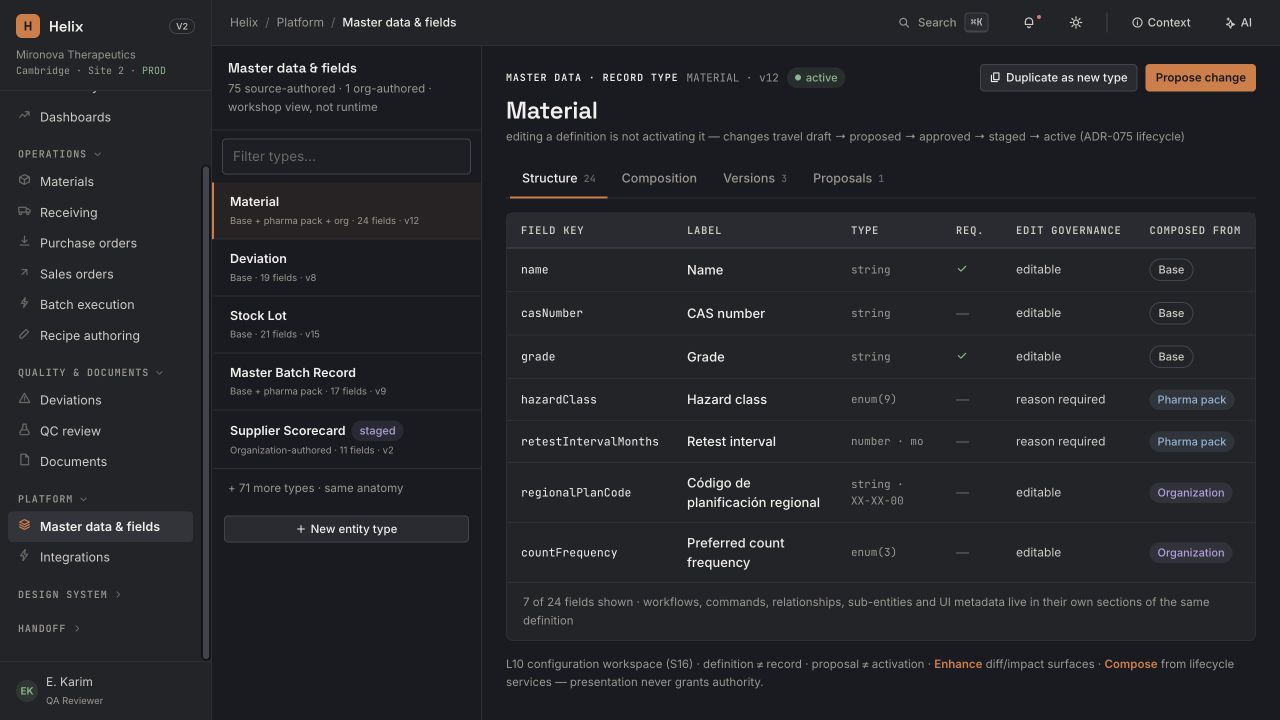
Helix Material entity type definition with typed fields and composition from shared, industry, and organization layers

This is the Material entity definition. It shapes material records and their forms; it is distinct from editing any one material record.

Interface reference · sample records
Open full size ↗
The connection that matters

A model change and a record revision do different jobs.

Requiring a witness on every record is a type-level rule. Revising the instructions in one approved recipe changes that specific record. Helix keeps those layers explicit.

01Entity type · structure
02Record · operating content
03Execution · actual work
Try the difficult path

Evaluate the behavior.
Not just the screen.

Plan your evaluation
Questions & answers

A few useful details.

Your next step

Put your operation on Helix.

Choose a template, shape your workspace, and try the work for yourself. The sandbox is free forever.

Try for yourself Explore plans & pricing